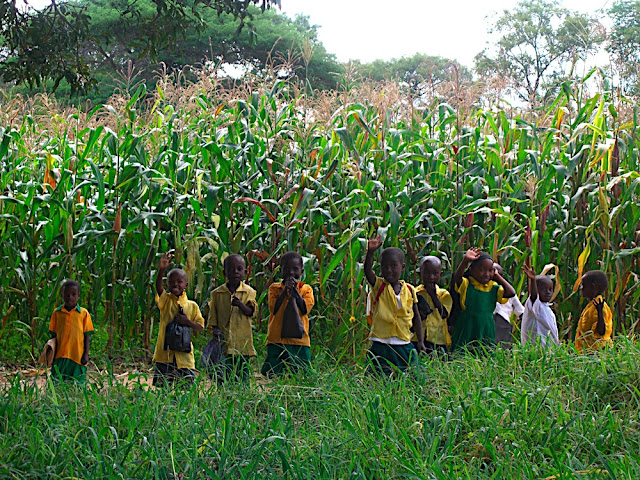
 Matt and I love living in a culture where it is considered important to greet people you meet and to take an interest in their lives. Matt, especially, takes the opportunity to strike up a conversation with random people he meets in the street! It can take a while to do your shopping but it certainly makes for a more interesting trip than just keeping your head down. At the moment, as well, it’s a great chance to practice Swahili. In Mbeya, we became known to a group of security guards who were thrilled that we were learning Swahili, even if it was ‘pole pole’-slowly! It can seem a little strange to the British-we often like to keep ‘ourselves to ourselves’ and find it too personal to enquire about people’s lives when we don’t know them. But it actually can be very liberating and fun!
So…I thought I’d teach you a bit about these crucial greetings even if you won’t have a chance to use them (let me know if you do though! Hee, hee), because they’ve become second nature to us. Firstly, there’s ‘Habari za…?’, which is literally ‘news of…?’. We’ve found that you can finish this enquiry with virtually anything! There’s the standard ‘Habari za asubuhi/mchana/jioni/usiku’ (morning/afternoon/evening/night). Then you can ask for news of their family, children and home (‘Habari za familia/ watoto/ nyumbani’) even if you don’t know them. Then you can ask for news of whatever you see them doing or whatever situation they appear to be in-‘Habari za kazi/masomo’ (work/studies) or even ‘…baridi/mvua’ (cold/rain! Yes, we do have them here!). As you can imagine, greetings alone can turn into quite a lengthy conversation!
Responses are just about always positive (strangely like in Britain!). The pat answer is ‘nzuri’ (good) or ‘salaama’ (peaceful). If you do have to say something negative, like if someone’s died, you can say ‘nzuri…lakini’ (good…but) or ‘nzuri tu’ (just good).
If the person is older or in a higher position of authority than you it is necessary to say ‘Shikamoo’-a term of respect literally meaning ‘I hold your feet’. It is also good to add ‘mzee’, ‘old person’(!) if it is an old man you are speaking to. Can’t see people taking too kindly to this in the West-they’d probably hit you!
In the morning you can say ‘Umelalaje?’ or ‘Umeamkaje?’. These are great Swahili sentences fitted into one word! They mean ‘How did you sleep?’ or ‘How did you get up?’, the answer of course being ‘Salaama’-peacefully.
You can also express sympathy for the person if they appear to be in unfortunate/undesirable circumstances by saying ‘pole’ This is a strange word as it can be used so widely-from a sore finger to someone dying or a car being wrecked. It is common to hear ‘pole za kazi/safari’ (sorry that you are working/traveling) and even (according to a friend in Mbeya ‘pole za kanisa’ (sorry that you’ve been to church! It’s hard to work that one out…is it to do with the hard benches or the long services, I wonder!).
Of course the ‘vijana’ (youth) don’t bother much with all this! The cool greetings are ‘Mambo’ with the responses ‘Poa’ (cool)/ ‘safi’ (clean)/ ‘freshi’ (fresh)! It seems ‘yoof’ (aka youth!) are the same the world over!
0 comments:
Post a Comment